Now Reading: Do Nail Strengtheners Actually Work? Your Complete Product + DIY Guide
-
01
Do Nail Strengtheners Actually Work? Your Complete Product + DIY Guide
Do Nail Strengtheners Actually Work? Your Complete Product + DIY Guide
Do Nail Strengtheners Actually Work? 5 Types Explained
Quick Answer: Yes, nail strengtheners work if you use the right type that addresses your specific nail problem. Products containing hydrolysed wheat protein, calcium, or hardening agents like formaldehyde resin reinforce the nail plate and reduce breakage. But nail strengtheners cannot reverse damage that is already done to existing nail cells. They support what is there while new, healthier growth comes in from the nail matrix below.
You paint on a strengthener every Sunday and wait, hoping it will fix your nails. But a week later, nails still peel at the tips and snap before they reach the end of your fingertip, and sometimes they start looking even worse. It is genuinely frustrating, especially when you invest in expensive products which guarantee results but don’t work.
In actuality, nail strengtheners are not a scam. Mostly they work but just in a different way than you expected, and sometimes you just don’t know which product your nails actually need. Here’s a breakdown of how nail strengtheners function at the nail plate level, which formats do what, the best DIY options that genuinely help and how to use them so you are not just painting on false hope week after week.
In This Post
- Why Are My Nails So Brittle? (And What That Has to Do With Strengtheners)
- Does Nail Strengthener Actually Work?
- Types of Nail Strengtheners: Which Format Does What
- DIY Nail Strengthener Options Worth Trying
- How to Use Nail Strengthener Polish Correctly
- Mistakes That Make Weak Nails Worse
- When Your Nails Might Be Telling You Something More
- Frequently Asked Questions About Nail Strengtheners
Why Are My Nails So Brittle? (And What That Has to Do With Strengtheners)
You genuinely need to know what is happening inside your nail so you can easily choose the right nail strengthener. Nails are made up of a fibrous protein named keratin, which layers itself in a compact structure forming the nail plate. Nails with well-hydrated keratin layers are slightly flexible and bend a little bit without breaking. But disrupted bonds make nails thin, peeling, brittle, or splitting at the free edge, and that’s exactly the problem you’re dealing with.
The disruption happens for several reasons, including prolonged water exposure, repeated hand washing, and dishwashing without gloves. Repeated wetting and drying make nails expand and contract repeatedly, which weakens the bonds between keratin layers. The natural upper layer of the nail plate is stripped away, damaging the nail bed, by gel and acrylic removal, especially when nails are soaked or filed aggressively. Protein and iron deficiency also affect the quality of growing nails, and sometimes it is simply genetics, like some people naturally produce a thinner nail plate than others.
The cause of your nail problem decides the type of nail strengthener you should use. Problems like overfilled, weak nails and brittle nails are addressed by entirely different products. What most reviews and product labels entirely skip is the fact that not every product works for every problem
Does Nail Strengthener Actually Work?
The short answer is yes, but there are special conditions you need to know about.
Nail strengtheners do one of these two things. Hardening-type strengtheners deposit minerals into the nail plate structure, which makes the nail more rigid and resistant to bending and snapping. Where flexible-type strengtheners maintain moisture within the keratin layers using proteins and conditioning agents, which reduces peeling and keeps the nail plate from drying and brittleness.
The American Academy of Dermatology says that keeping nails and surrounding skin moisturised is one of the most effective steps for managing brittle nails. But many modern nail strengtheners usually incorporate exactly this approach by combining light hardening agents with moisturising ingredients, trying to address both problems at once.
What has already happened to your nails cannot be fixed by applying strengtheners. The existing nail plate that is damaged will grow out slowly in about three to six months because fingernails grow roughly 3mm per month. A nail strengthener supports the existing plate and protects new growth coming from the nail matrix below. This process needs consistency and patience more than technique, as visible results will appear in about 4 to 6 weeks.
Types of Nail Strengtheners: Which Format Does What
Not all nail strengtheners are the same product. The format and ingredient list matter a lot.
Nail Strengthener Polish
The most common format when mentioned is “nail strengthener”. It is like a reinforcing layer that applies like a regular base coat, dries clear or slightly pink and sits on top of the nail plate. One of its best formulas contains hydrolysed wheat protein or silk amino acids to bond to the keratin structure of the nail. Some also contain calcium for added hardness.
Preferred to wear alone for maximum results, but can also be applied as a base coat under any nail paint. The key to having good results is consistency; applying once and forgetting about it does not accomplish much. It’s good to refresh every two to three days for continuous protection.
Nail Hardener
A nail hardener is technically a subcategory of nail strengthener but with quite an aggressive formulation. Classic nail hardeners contain low concentrations of formaldehyde or its derivatives, which make nails rigid by creating cross-links between the keratin chains in the nail plate a mechanism the FDA confirms is how formaldehyde-based hardeners work.
Nail hardeners work extremely well when nails are severely soft or peeling in the short term. But prolonged use can over-harden the nail plate, which increases the risk of cracking rather than bending. The biggest mistake people make is using nail hardeners continuously for months without a break. Most formulas are not designed to be used permanently; rather, the treatment cycle is only 2 to 4 weeks.
Nail Strengthening Cream and Serum
A nail-strengthening cream or serum works differently from a polish-based product. It penetrates the nail plate rather than sitting on top of it, containing Ingredients like panthenol, biotin and urea that draw moisture into the keratin layers to help prevent the micro-cracks that lead to peeling. It is applied directly to bare nails and the surrounding skin, especially at the seal between the nail plate and nail bed at the free edge, called hyponychium, which is often the first area to dry out and break down.
Creams and serums are especially effective at night when there is no polish barrier blocking absorption.
Natural and DIY Nail Strengtheners
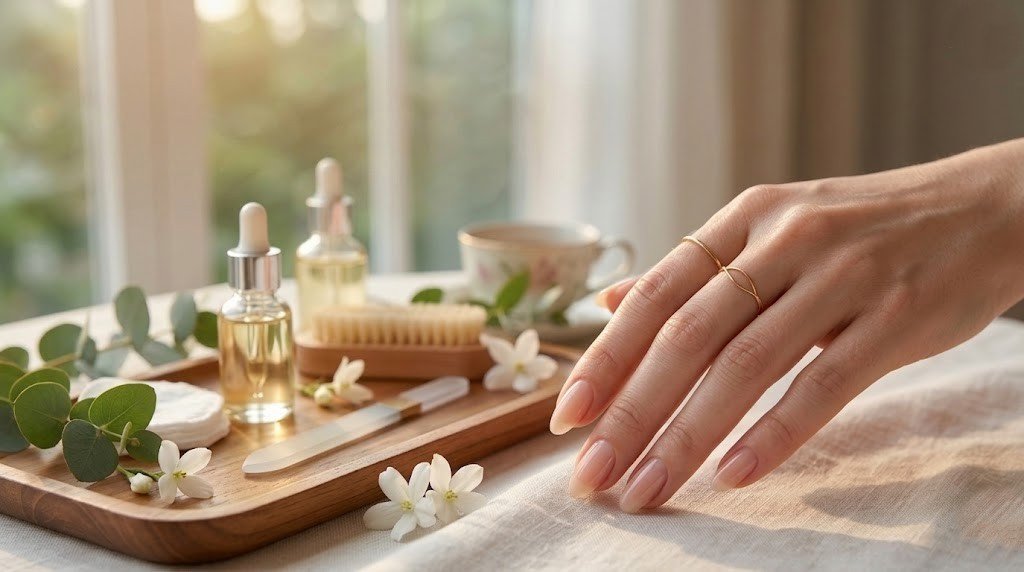
Ingredients like jojoba oil, argan oil, and vitamin E applied directly to the nail plate and nail fold do have real moisturising benefits at the keratin level. They do not harden nails like a formaldehyde-based product but genuinely work for dry and peeling nails rather than structurally damaged nails. They function as a legitimate natural nail strengthener when used consistently.
DIY Nail Strengthener Options Worth Trying
Weak nails don’t always need a product; instead, several kitchen cabinet ingredients work perfectly as natural nail strengtheners if used consistently.
Jojoba oil is structurally similar to the natural oils produced by your skin and readily absorbs into the nail plate and surrounding skin. Massage each nail and surrounding skin with a few drops every evening before bed. It does not harden the nail plate, but it significantly reduces the moisture loss that causes peeling.
Vitamin E oil is squeezed directly from a capsule or used as a dedicated oil and supports the nail bed and surrounding skin, which indirectly helps to maintain a healthy attachment between the nail plate and the structures beneath it. It particularly works more effectively for nails that split at the sides near the nail fold.
A diluted apple cider vinegar soak (one part ACV to three parts warm water, for five minutes) is often recommended online as a nail-hardening treatment. The evidence here is thin, and it can be drying if used too frequently. Skip this one in favour of the two above.
A high-protein diet is the DIY option nobody talks about enough. Nail matrix produces keratin from dietary protein, and consistently low protein intake in the diet directly affects the quality of new nail growth. You must take a look at your nutrition if your nails have been thin and slow-growing for years.
How to Use Nail Strengthener Polish Correctly
Most people assume that nail strengtheners are ineffective and do not work, but they are not; instead, using them in the wrong way makes them ineffective. The application method matters a lot in gaining the right results.
Start with completely clean and bare nails. Any oil, including the natural oils from your fingertips, prevents the formula from bonding properly to the nail plate. Clean each nail thoroughly with a lint-free pad dampened with acetone or nail cleanser before you begin.
Apply only one thin coat and not two thick coats; trap solvent underneath and take far longer to actually dry, and they peel rather than adhering to the nail. Let each nail of one hand dry fully before moving to the next hand. These drying tricks work just as well on strengthener as they do on regular polish.
Don’t wait for the coat to chip off; instead, reapply every two to three days regularly. A fresh coat layer over a clean base keeps the reinforcing barrier intact and consistent.
Every two to three weeks, completely clean the nail and remove nail strengthening layers using non-acetone remover and then restart the process. Acetone can dry nails if used frequently, particularly for already-brittle nails.
How to Strengthen Nails After Gel
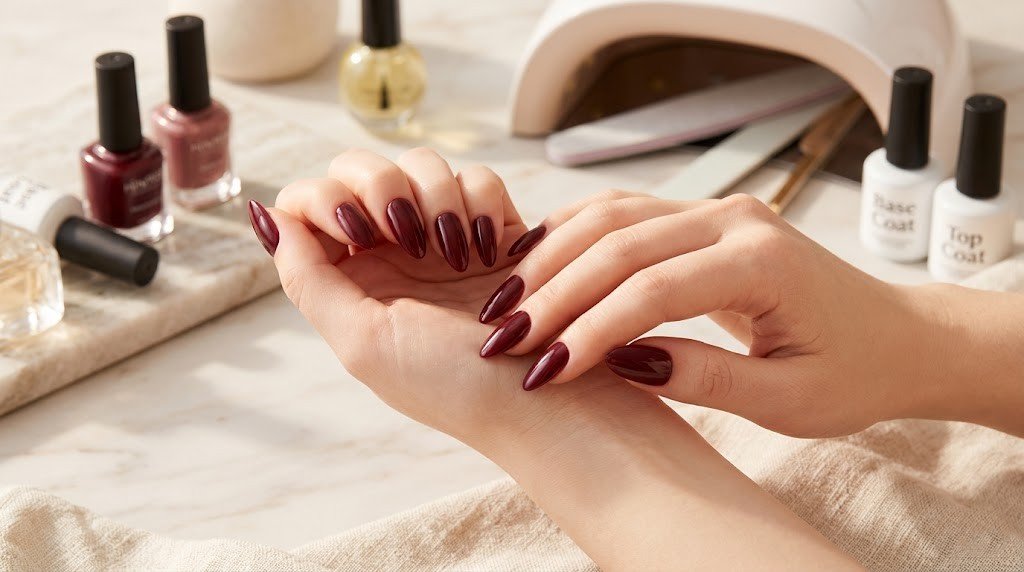
Gel removal, whether from regular gel polish or extension systems like Gel X, is one of the most common causes of weakened nail plates. When the gel is removed, the surface layers of the nail plate are often thinned, making the nail feel soft, bendy, and sore at the free edge. If you’re removing it yourself, doing it the right way makes a real difference in how much damage is done in the first place. Start with a flexible nail strengthener formula rather than a hardener because the nail needs to recover its moisture first before it can benefit from added rigidity. Use a nail strengthening cream at night alongside the polish during the day, and avoid gel for at least 4 to 6 weeks while the nail matrix grows out new with undamaged cells.
Mistakes That Make Weak Nails Worse
This is where most nail care routines quietly fall apart. Getting the product right matters, but making these mistakes undoes all the effort.
Using a nail hardener continuously for months. Hardening formulas are not maintenance products; rather, they are treatment products. After 4 weeks of consistent use, switch to a flexible strengthener or a nourishing base coat. Over-hardened nails are more prone to snapping than bending, and that feels worse than the original brittleness.
Skipping gloves at the sink. Water is the number one enemy of a weakened nail plate. Every time wet nails dry out, the layers of keratin contract. Repeated swelling and shrinking are one of the most damaging things that happen to brittle nails, and this happens on a daily basis. Make a habit of using rubber gloves during dishes and cleaning. It just takes 30 seconds to put on and genuinely change your results.
Peeling off gel or polish instead of soaking. Every time you peel this, physically remove the upper layers of the nail plate along with the product. Those layers do not grow back, and they have to be replaced by new growth from the nail matrix and that can take weeks. Always remove polish properly and do not peel.
Applying nail strengthener over oily nails. This is the most overlooked step. Any oil present on the skin will not form a strong bond with the nail plate, and it will peel off. Oil can be from your moisturiser or hand cream applied an hour earlier, so clean your nails before every application.
Expecting results in a week. A nail strengthener protects the nail that already exists and supports the new growth coming in. This process is slow, so you will not see a transformed nail in seven days. Be patient and give it a full growth cycle, four to six weeks minimum, before judging whether a product is working.
When Your Nails Might Be Telling You Something More
Most brittle and weak nails are due to moisture, mechanical damage or product overuse. But occasionally, nail changes are the body’s way of flagging something happening inside your body that is worth paying attention to.
If your nails are consistently thin, brittle, spoon-shaped and curve upward at the edges rather than lying flat, this can be a sign of iron deficiency anaemia. Anaemia is a condition your doctor can identify with a simple blood test. Horizontal ridges across the nail plate, significant white spots that don’t grow out, or nails that have thickened and darkened over time are all worth mentioning to a dermatologist. The same goes for persistent splitting that does not improve after 8 to 12 weeks of consistent brittle nails treatment.
These symptoms are rarely serious, but they are the nail matrix’s way of asking for a closer look.
Frequently Asked Questions About Nail Strengtheners
What is the best nail strengthener for weak nails?
For nails that are soft and bendy, a formula containing calcium and hydrolysed protein is a strong starting point. For dry and peeling nails rather than soft, a flexible strengthener or a nail strengthening cream used overnight will typically outperform a hardening polish. The best product depends on the type of weakness you are dealing with, not on a universal ranking.
What strengthens nails most effectively?
Consistency is the real answer. A mid-range strengthener applied correctly and refreshed every two to three days will outperform an expensive product used once a week. Beyond topical products, adequate protein and hydration in your diet directly support the keratin production happening in your nail matrix, meaning what you eat affects how strong your nails grow from the base.
How long does it take for a nail strengthener to work?
Give any nail strengthener four to six weeks before drawing conclusions. Fingernails grow approximately 3mm per month, and the goal is to protect existing nails while new and healthier growth comes in from the nail matrix. Expecting a visible difference in under two weeks is one of the most common reasons people abandon products that would have worked with more time.
Can I use nail strengthener under regular polish?
Yes, and this is actually the best way to use most nail strengthener polish formulas. Apply one thin coat to clean and bare nails, then let it dry fully, followed by applying your colour on top. The strengthener acts as a reinforcing base coat. Remove everything together at your next polish change, clean the nail plate thoroughly, and reapply before your next colour.
Do nail hardeners and nail strengtheners do the same thing?
Not exactly. A nail hardener uses cross-linking agents, typically formaldehyde resin or its derivatives, to make the nail plate rigid and resistant to bending. A nail strengthener is broader in scope and may harden, moisturise, or reinforce keratin depending on the formula. All nail hardeners are nail strengtheners, but not all nail strengtheners are hardeners. For very soft nails, start with a hardener. For dry, peeling nails, reach for a strengthening and conditioning formula instead.
Weak nails are rarely a permanent situation. They are usually a signal of moisture imbalance, mechanical damage, product misuse, or sometimes nutrition, and once you understand the signal, the solution becomes a lot clearer. The right nail strengthener for your specific nail plate genuinely does make a difference if applied consistently and correctly. It just takes a full growth cycle to see it.
If you are starting from scratch, pick your formula based on what your nails actually do: harden for soft and bendy, nourish for dry and peeling. Stick with it for six weeks. And give your nails a break from heavy gel and acrylics while you work.
For more on building a routine around healthier nails, take a look at our complete natural nail care routine guide