Now Reading: How Long Does Nail Polish Take to Dry? Science + Tips
-
01
How Long Does Nail Polish Take to Dry? Science + Tips
How Long Does Nail Polish Take to Dry? Science + Tips
How Long Does Nail Polish Take to Dry? The Real Answer
Quick Answer: Nail polish feels dry enough to touch in about 1 to 2 minutes for each coat, but it takes a full 10 to 15 minutes to completely stop smudging. To fully cure it hardens all the way through the nail plate, and regular polish needs up to 2 hours. Thin coats and a quick dry top coat with little patience are a trick to cut down wait time significantly.
You finish painting your nails and wait what feels like forever, but still it smudges. It happens to almost everyone. The frustrating part is not knowing how long you actually need to wait, so you either rush it and ruin everything or sit frozen for twenty minutes wondering if it is safe to move yet.
Here you will find the real nail polish dry times broken down by coat and the science behind why polish takes as long as it does, along with covering methods that genuinely speed things up without ruining your manicure. This post covers everything you need to know, whether you are working with a regular formula, a gel-like polish, or any fast-drying top coat.
In This Post
- What Actually Happens When Nail Polish Dries
- How Long Does Nail Polish Take to Dry — By Coat and Formula
- How Long to Wait Between Coats of Nail Polish
- How to Make Nail Polish Dry Faster
- Does UV Light Dry Regular Nail Polish?
- Why Won’t My Nail Polish Dry?
- When Your Nails Are Telling You Something More
- Frequently Asked Questions About Nail Polish Dry Time
What Actually Happens When Nail Polish Dries
Nail polish is not just color in a bottle, but it is a carefully balanced formula of pigments, resins, plasticizers, and solvents that evaporate on drying.
When you brush polish onto the nail plate, it makes the solvents evaporate immediately on contact with air. This allows the resins and film-formers to bond together, forming a smooth, glossy layer on a hardened nail surface. But solvents evaporate from the top down, resulting in the surface feeling dry long before the deeper layers have finished curing, and that is when you think it’s dry and can smudge a nail.
The coat thickness and some atmospheric effects also contribute to the fast evaporation of solvents, including temperature, humidity, and airflow. Warm and humid air slows evaporation while cool and dry air speeds it up. This makes sense when you know the chemistry behind it, and once you understand it, the speed tips in this post will not feel like random tricks.
How Long Does Nail Polish Take to Dry By Coat and Formula
This question has no single solid answer because nail polish dry time depends on what you are applying and how many layers deep you are. Here is a realistic breakdown to estimate the dry time according to the layers you have applied.
Base Coat
A base coat is the very first layer that is thinner than color polish and typically dries to the touch in 1 to 2 minutes, so wait at least 2 minutes before applying your color coat. Rushing this step will eventually lead to peeling color coats, as they need a properly set base coat to bond well to the nail plate.
Color Coat
Each color coat takes roughly 2 to 3 minutes to dry enough to be touched, but touch-dry is not smudge-proof. Brushing again within 2 minutes will leave a dent that you would not notice until it was too late. The safe rule is to wait patiently for a full 3 to 5 minutes between each color coat, especially with darker or more pigmented shades, because they tend to be slightly thicker formulas.
Top Coat
Top coats vary widely as they are the ones that give color coats the final gloss and shine. A standard top coat takes about 5 to 10 minutes to feel fully set on the surface. A quick-dry top coat can reach that surface-dry point in 60 seconds, but neither one means your manicure is bulletproof yet.
Drying vs. Fully Curing: The Difference Matters
The fact that most people aren’t aware of is that surface drying and full curing are two completely different things.
Surface dry means the top feels hard, whereas full cure refers to drying of the entire formula with complete hardening of all the layers down to the nail plate. A full cure takes about 2 hours for regular nail polish, and your nails are more vulnerable than they look during that window. Washing dishes with bare nails or using nails for opening, or even digging through a bag, can cause dents on solid surfaces too.
How Long to Wait Between Coats of Nail Polish
Most people want this duration to be as short as possible, but the answer that actually protects your manicure is longer than that.
A 2-minute but better three-minute wait between each coat provides a safer dry. You need more patience for applying multiple layers of rich or dark shades that have thicker layers, but it is the difference between a manicure that lasts five days and one that chips by evening.
Layering polish before the previous coat means setting a trap for solvents underneath by preventing them from bonding with air and escaping. This makes the lower layers stay soft longer, where the whole manicure takes forever to cure, and the smudging risk stays high across all layers. A hand on a brush is needed to apply thin coats with patience that actually outperform thick coats applied fast every single time.
How to Make Nail Polish Dry Faster
These methods are not gimmicks; they work with the chemistry of nail polish. For the full list, including a few tricks not covered here, see 12 ways to dry nails fast.
1. Apply Thin Coats
Thin coats expose more surface area to air, meaning giving solvents escape surface to bond with air faster across the whole layer rather than being trapped at the base. Two thin coats dry faster than one thick coat, so have a grip on the brush and load less polish than you think you need and spread it smoothly over the nail plate, giving time to do its thing.
2. Use a Quick Dry Top Coat
A quality quick-dry top coat contains fast-evaporating solvents that speed up the drying all the way to the base layer, not just the top coat itself. The most effective single step is to apply it over your final color coat before that coat is fully dry for best results.
3. Try the Cold Water Dip
Fill a bowl with cold water and a few ice cubes. Wait two minutes after your last coat and then submerge your fingers for about 3 to 5 minutes in cold water. Feeling water beading on the surface of the nails is a sign that the polish has set. The cold constricts the formula slightly by speeding up surface hardening and significantly reduces full cure time, but does not cut it down.
4. Use Quick Dry Drops
Quick dry drops or drying oil are different from regular cuticle oil and work by sealing the surface of the polish and locking in the formula. Gently spreading a drop or two on each nail with the dropper reduces surface dry time by about a minute. Many formulas moisturize the skin around the nail fold at the same time.
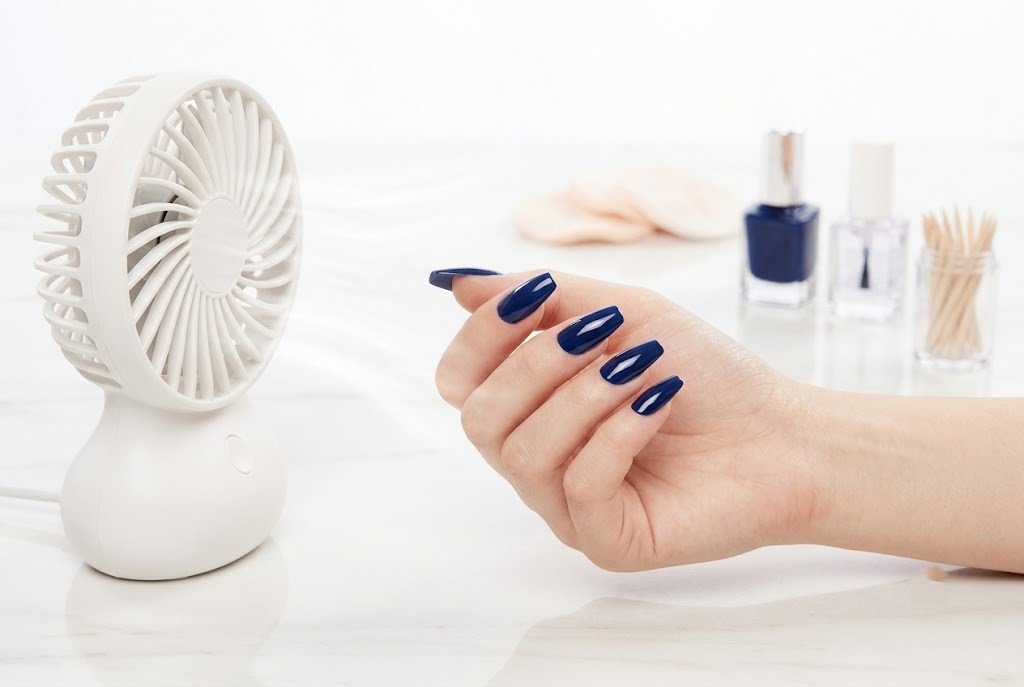
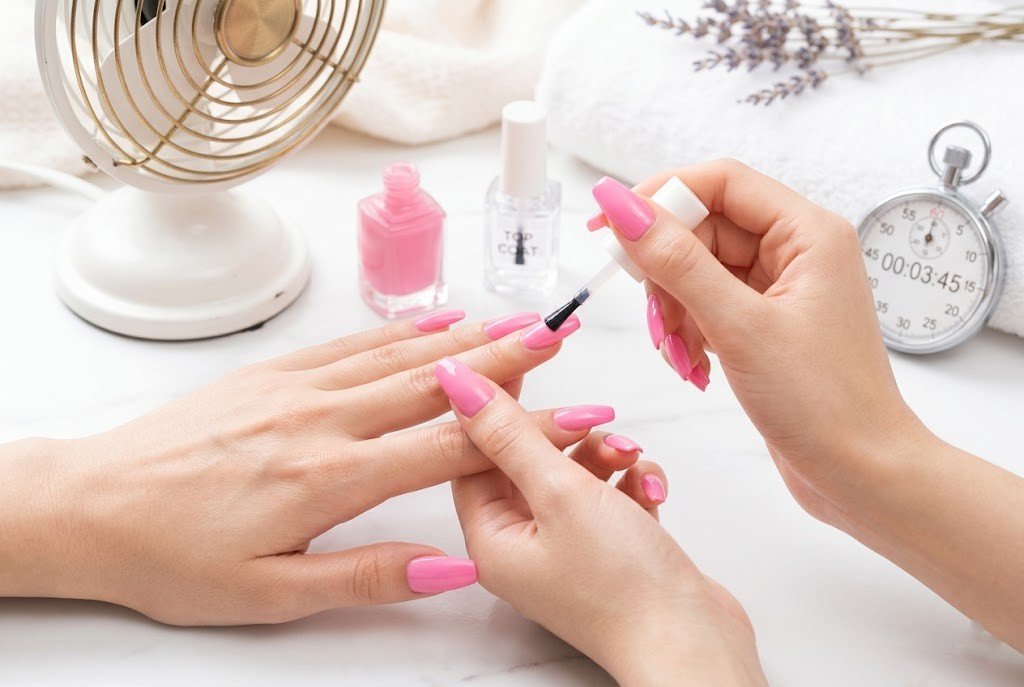
5. Use Cool Air from a Fan or Hairdryer
Cool air accelerates solvent evaporation, which is exactly what drying needs. Gently blowing fans across nails works well, and also setting the hairdryer to cool works significantly. Hot air will work the opposite of what you want because heat softens nail polish rather than hardening it.
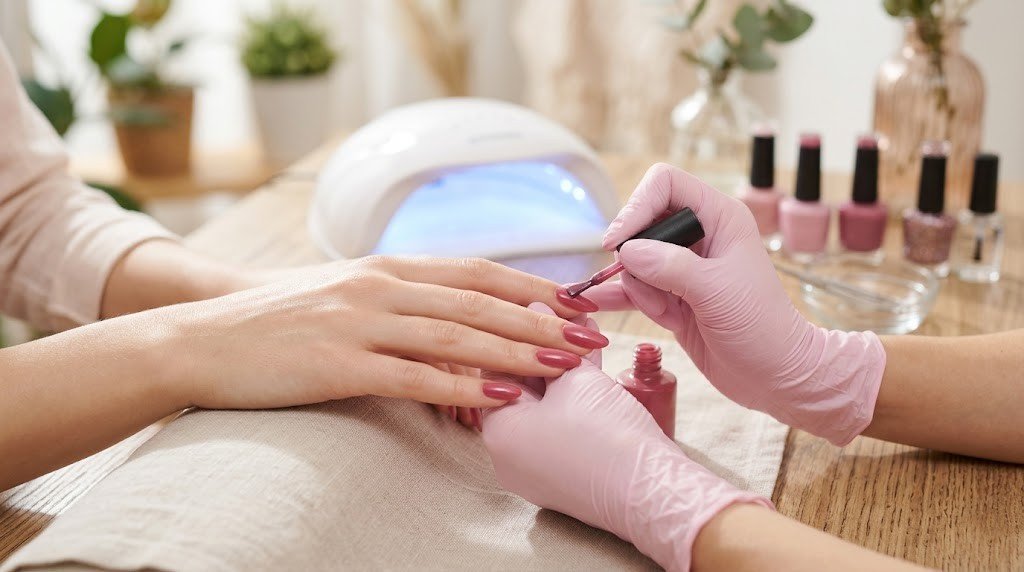
6. Try a UV Nail Lamp With One Important Caveat
UV and LED lamps cure gel polish through a photochemical reaction. Regular nail polish does not contain the photoinitiators that gel does, so a lamp will not cure it the same way. Some regular polishes will feel slightly harder after lamp exposure, but this is heat-related, not a true cure. If you want lamp-cured nails, gel polish is the formula you need.
Does UV Light Dry Regular Nail Polish?
Not in a significant way. This is one of the most common nail questions and has a very surprising answer.
UV and LED lamps work by triggering a chemical reaction in gel polish called photopolymerization. Regular nail polish does not contain the photoinitiators needed for that reaction, so placing your hands under a lamp will not cure it the way gel cures; rather, the lamp may generate a little heat that will not dramatically shorten your wait time, and it will not deliver the hard and fully cured result that you get with gel.
If you aim for quick lamp-cured nails, then switching to a proper gel manicure is a good choice, or a peel-off gel hybrid is the actual solution because regular polish and UV lamps are simply not designed for each other.
Why Won’t My Nail Polish Dry?
If your polish is still tacky after fifteen or twenty minutes, that means something is off. Some common reasons are:
Coats applied too thick. Thick layers trap solvents underneath and slow everything down, and make the surface dry over while the middle stays soft for an hour.
Too many coats applied too quickly. Stacking coats before the previous coat sets traps solvents between layers, which makes the manicure soft and more prone to dent for a longer time than it should be.
High humidity. Humid air carries moisture that slows evaporation, so your nail polish dry time genuinely increases on a very humid day.
Old or thickened polish. As nail polish in the bottle ages, it makes solvents in the bottle evaporate and leave behind a thicker, slower-drying formula. Adding a drop or two of nail polish thinner, not remover, can help, but not for very old polish.
Wrong layering order. Stacking thick layers of color coats over a thick layer of base coat creates a stack of wet layers that take forever to sort themselves out.
When Your Nails Are Telling You Something More
Nail polish issues are purely cosmetic, may be a technique problem or a formula problem, and nothing more. But nails that constantly feel soft and peel at the surface, refusing to hold polish well, are a signal of something happening underneath.
Nails that are chronically soft, thin, or prone to peeling can sometimes reflect nutritional gaps of biotin, iron, or protein. We cover this in detail in our guide to brittle nails and vitamin deficiency. And sometimes it may be an underlying skin condition affecting the nail matrix. If you notice nails changing texture or appearance and it is not related to product use, then it is worth mentioning to a dermatologist. They can read the nail bed and matrix properly and rule out anything that needs attention.
Frequently Asked Questions About Nail Polish Dry Time
How long does it take for nail polish to fully dry?
Surface dry happens in 1 to 2 minutes per coat, but full cure, where the formula hardens all the way through, takes up to 2 hours for regular polish. During that window, your nails are more vulnerable than they feel. Gentle handling for at least an hour after your final coat protects your manicure from dents and smudges that seem to come from nowhere.
How long to wait between coats of nail polish?
Wait a minimum of 2 to 3 minutes between every coat, base coat, color coats, and top coat. This gives each layer enough time to begin setting, so you are not trapping wet solvents under fresh polish. Rushing between coats is one of the main reasons manicures stay tacky for hours and chip faster than they should.
How long does gel nail polish take to dry?
Gel polish does not air dry; instead, it cures under UV or LED light through a chemical reaction. A UV lamp typically cures each coat in 2 minutes. An LED lamp cures in 30 to 60 seconds per coat. Without a lamp, gel polish stays wet and tacky indefinitely, which is why gel and regular polish are fundamentally different systems.
Does UV light dry regular nail polish?
No, not effectively. UV and LED lamps are designed for gel formulas that contain photoinitiator chemicals that react to light and harden. Regular nail polish does not contain these, so a lamp will not produce a proper cure. Stick to cold water, quick-dry drops, or a fast-drying top coat for regular polish.
Why does my nail polish take so long to dry?
The most common culprits are thick coats, too many layers applied too quickly, high humidity, and old, thickened polish. Switching to thin coats, waiting properly between layers, and using a quick-dry top coat resolve the issue in most cases. If humidity is the problem, then painting your nails in an air-conditioned room helps more than any product.
Nail polish dry time is one of those things that feels like guesswork until you understand what is actually happening. Once you know that polish dries from the outside in, that touch-dry and fully cured are two very different states, and that thin coats with patience outperform rushing every single time, your manicures get better almost immediately.
The single biggest change is to slow down between coats and finish with a proper quick-dry top coat. Those two steps alone will transform how long your nails actually last. When you are ready to build on this, our complete at-home manicure guide walks through the full process from prep to finish, so every coat goes on cleanly from the start.