Now Reading: How Long Does a Gel Manicure Last? (Week-by-Week Guide)
-
01
How Long Does a Gel Manicure Last? (Week-by-Week Guide)
How Long Does a Gel Manicure Last? (Week-by-Week Guide)
How Long Does a Gel Manicure Last, And How to Extend It
Seeing your nails lifted at the edges after just four days of a fresh gel manicure is one of the most frustrating things. You paid for it and sat patiently through the curing while being careful, but still, you are already losing the battle. Most women face this issue, and it’s not related to just bad luck.
Gel manicures have earned a massive reputation for being the low-maintenance solution for those who are tired of chipped nails, and they genuinely work like magic on your hands if they are done flawlessly. This post answers exactly that question: how long does a gel manicure last, along with covering what a healthy lifespan looks like week by week, and how daily habits protect or quietly destroy your polish before its time. This guide tells you exactly what you need to know before your next salon appointment, whether you’re a salon regular or experimenting at home.
Quick Answer: A gel manicure typically lasts two to three weeks. How long gel manicures last in practice depends on three things: how well your nails were prepped before application, the quality of the gel and curing process, and how you treat your hands after the manicure. You can comfortably reach the two-week mark with no lifting or chipping if you take good care afterwards. Reaching three weeks requires consistent daily habits that should not be compromised.
In This Post
- How Long Does a Gel Manicure Last? The Real Answer
- What Actually Determines Gel Manicure Longevity
- Week-by-Week: What to Expect From Your Gel Manicure
- How Long Should a Gel Manicure Last? Salon vs. At-Home
- How to Make Gel Nails Last Longer: 6 Proven Tips
- Why Does My Gel Polish Peel Off?
- Mistakes That Cut Your Gel Manicure Short
- Frequently Asked Questions About Gel Manicure Lifespan
How Long Does a Gel Manicure Last? The Real Answer
The honest answer is that they last anywhere from two to three weeks, but that specific range hides a lot of variation based on how well you take care of your hands and the natural strength of your nails
On the shorter end, you might see some annoying lifting by day ten, while on the longer end, a professionally prepped salon set applied carefully on healthy nails with diligent aftercare can hold strong for twenty-two or even twenty-five days. How long does gel polish last beyond that? Technically, the polish itself doesn’t disintegrate or wear off but your natural nail grows roughly three millimetres per month so the gap between your cuticle and the gel edge becomes visible enough that the manicure looks grown out regardless of whether it’s still adhered.
The real lifespan question isn’t just about chipping, but it’s heavily focused on how long your gel looks presentable and stays structurally sound and these two very different clocks running simultaneously.
Most nail professionals recommend a refresh every two to three weeks to give nails a window that respects both the adhesion limits of the gel and the natural growth cycle of the nail plate.
What Actually Determines Gel Manicure Longevity
The true lifespan of gel polish isn’t just a matter of random luck. It comes down to three distinct factors.
Your Natural Nail Condition
The nail plate is the foundation of the nail that holds everything. Gel bonds to keratin, which is the protein that makes up your nail, so if your nail plate is thin or weakened from previous gel removal means that the bond is working against a compromised surface from the start. Oily nail beds are another underappreciated factor, as some women naturally produce more sebum around the nail fold, meaning the gel has to work harder to adhere and may lift sooner at the edges.
Application and Prep Quality
The initial preparation stage is not optional for a gel manicure. Proper prep includes pushing back cuticles and lightly buffing the nail surface for adhesion, along with dehydrating the nail plate to remove oils, and applying a bonding base coat to cap the free edge. The same steps are covered in detail in our full gel manicure guide. Skipping any of these steps can dramatically reduce lifespan. Enough UV lamp curing also matters because under-curing leaves the gel soft beneath its surface, and this becomes the reason for faster peeling of at-home manicures.
Your Daily Lifestyle
This factor is mostly within your control if you stick to some small habits that actually contribute to increasing the lifespan of a gel manicure. Avoiding frequent exposure to water or harsh chemicals of cleaning products and manual work all place stress on the gel layer that weakens the bond between gel and nail. Every soak in hot water slightly softens and swells the nail plate, and every cleaning product has chemicals that reach your nails, chip away the top coat and seal.
Week-by-Week: What to Expect From Your Gel Manicure
Days 1–3: Peak gel when the finish is glassy and edges are clean with a strong bond. Avoid prolonged hot water during this window to give the seal enough time to fully set.
Days 4–7: Still looking great and holding the gloss, but this is the week when lifestyle starts to matter, and women who wash dishes without gloves often see the first signs of edge lifting here.
Days 8–14: The sweet spot where a well-applied gel manicure is still chip-free and glossy, but the nail growth is becoming noticeable near the cuticle, creating a faint gap, but it’s completely normal.
Days 15–21: The final chapter. The gel may still be intact, but the visible gap near the cuticle grows and causes lifting at the edges. Edges catching on fabric or hair mean it’s time to book removal, not because the gel failed, but because the nail has grown out from under it.
Beyond day 21: The grown-out look and potential for moisture getting under lifted edges make removal the right call. Leaving gel on past this point increases the risk of nail damage rather than extending your manicure.
How Long Should a Gel Manicure Last? Salon vs. At-Home
How long do gel nails last when you do them yourself versus professionally? The gap between longevity and overall durability is real.
Professional salon: Stays perfect for two to three weeks when the technician is trained and controls every variable, nail plate preparation, product quality, UV lamp calibration, and layer thickness. These aren’t small details since they represent the difference between gel that stays and gel that peels.
At-home application: One to two weeks is the honest expectation for most beginners. The biggest weak points are lamp quality (consumer lamps often under-cure), thick layers (too much gel in one coat prevents full curing), and, most importantly, skipping initial prep. A soft gel manicure system designed for home use can close that gap somewhat, but still requires careful prep.
The good news is that at-home gel improves with practice, and you’ll see layers getting thinner by your third attempt, and better prep comes naturally, which improves your wear time.
How to Make Gel Nails Last Longer: 6 Proven Tips
These address specific failure points instead of just giving you generic advice that you already know.
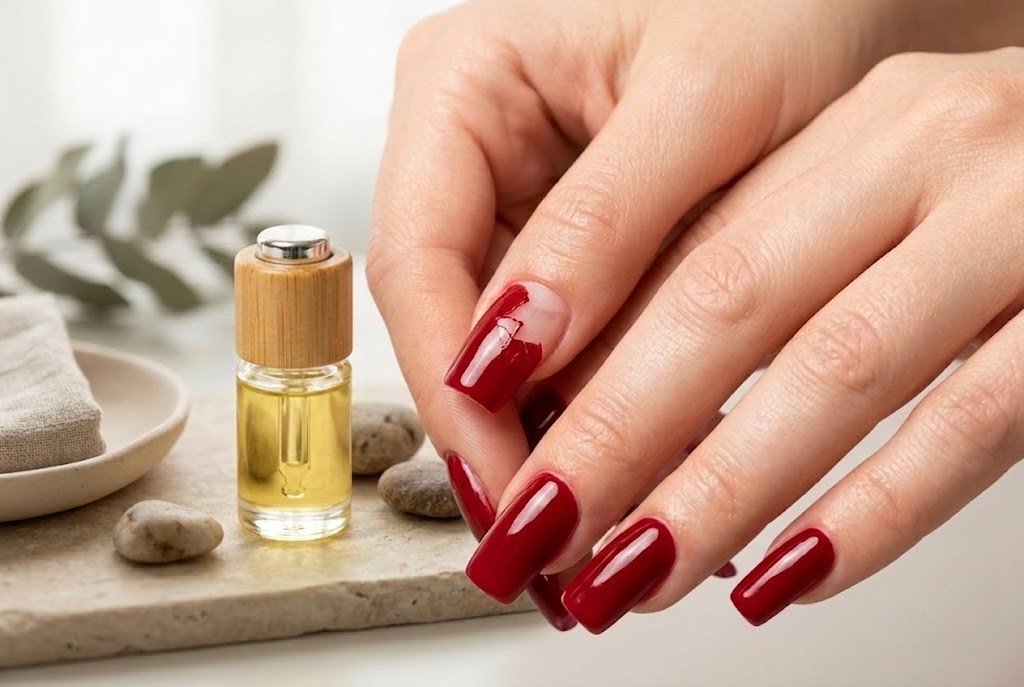
- Apply cuticle oil daily. Hydrated nails are more flexible and reduce the micro-stress that causes edge lifting. Apply one drop of cuticle oil per nail daily, morning and evening. This single habit makes more of a difference than most people expect.
- Wear gloves for washing up. Hot water and dish soap degrade your gel seal faster than almost anything else. It just takes five seconds to put on rubber gloves, and it can add days to your wear time.
- Cap your free edges. Run the brush along the very tip of the nail with base coat, colour coat and top coat. This seals the edge and dramatically reduces tip chipping. Most peel-off situations start at an unsealed tip.
- Reapply top coat on day seven. A fresh layer of top coat at the end of week one buys real extra days by replenishing the protective seal without disturbing the colour beneath.
- Avoid using your nails as tools. Opening packages, peeling stickers, and scraping surfaces with nails are actions that apply targeted leverage and break the gel seal at the free edge.
- Give your nails recovery time between sets. Healthy nails hold gel longer. A strong nail plate is the best gel manicure tip there is, so allow a few days of recovery after removal before booking your next appointment.
Why Does My Gel Polish Peel Off?
This question comes up constantly, and the answer almost always lives in one of four places.
Prep was skipped or rushed. Peeling in sheets within the first week means the nail plate wasn’t properly dehydrated before application, so the invisible oil barrier prevented true bonding, and the gel cured from the surface, but it never truly adhered.
The gel was applied too thickly. A thick layer cures on the surface but stays semi-flexible underneath, and that underlayer eventually separates from the nail plate. Always apply thin coats and fully cure each one under a UV lamp.
Gel touched the skin during application. Any contact with the skin around the nail fold creates a weak point where peeling begins. The gel bonds to the nail plate, not skin, so any overlap becomes an entry for lifting.
The nail plate was compromised. Repeated improper removal by scraping or peeling instead of soaking eventually thins the nail plate. Thinner nails are more flexible and more prone to damage, which means worse adhesion on every subsequent set.
Mistakes That Cut Your Gel Manicure Short
Skipping the base coat. Applying a colour coat without a base coat means you’re applying colour to a surface the gel was never formulated to bond to in the long term. Because the base coat creates adhesion between gel and nail, early chipping within the first few days is a reliable sign that this step was cut.
Peeling off lifting gel. Dermatologists warn that peeling gel from the nail, this pulls away the top layers of the nail plate with it. The nail becomes thinner and takes longer to hold the next set properly. Always soak off, never peel.
Getting a new set immediately after removal. Your nail plate needs time to rehydrate after acetone soak-off, so do not book the same day for a new manicure; instead, give temporarily dehydrated and vulnerable surface time to regain its natural condition.
Ignoring a lifted edge. A small lift creates a gap for moisture and bacteria to enter. Address it early with a drop of nail glue as a temporary fix, or simply book removal before it spreads further.
Frequently Asked Questions About Gel Manicure Lifespan
How long does gel nail polish last compared to regular polish?
Regular polish lasts five to seven days before chipping noticeably. Gel nail polish lasts two to three weeks because it is cured under UV or LED light into a hardened polymer layer. Gel forms a cross-linked molecular network that air-dried regular polish simply cannot replicate, which is why the difference in wear time is so significant.
Why is my gel polish peeling off after just a few days?
Early peeling in large pieces almost always points to a prep issue: the nail plate wasn’t properly dehydrated before application, leaving an oil barrier that prevented true adhesion. It can also happen if gel was applied touching the cuticle skin, or if layers were too thick to cure fully through.
How long does a gel pedicure last compared to a manicure?
A gel pedicure typically outlasts a hand manicure by one to two weeks because toenails grow more slowly and face significantly less daily stress from typing, gripping, or washing up. Most women find their gel pedicure stays presentable for three to four weeks comfortably. The same range as dip powder nails, which is worth knowing if you’re deciding between the two.
Are gel manicures bad for your nails?
Gel itself is not inherently damaging. Dermatologists agree that the damage associated with gel almost always comes from improper removal by peeling or scraping instead of acetone soak-off and from back-to-back sets without recovery time. Gel is a manageable long-term choice for most nail types if it’s done correctly.
Your gel manicure lifespan is not fixed; rather, it is the sum of everything that happens before, during, and after your appointment, including the prep, the curing, the small daily decisions about gloves and hot water and cuticle oil. Two to three weeks is the standard, but how long a gel manicure lasts for you specifically depends on how much of that process you control.
Most manicures look their best in the first ten days and simply need support after that. A little cuticle oil, a glove at the sink, a refreshed top coat at day seven and none of it is hard. All of it adds up.
Start with one habit this week. And when you’re ready to take it off safely, here’s how to remove gel nail polish at home.