Now Reading: How to Remove Gel Nail Polish at Home (Without Wrecking Your Nails)
-
01
How to Remove Gel Nail Polish at Home (Without Wrecking Your Nails)
How to Remove Gel Nail Polish at Home (Without Wrecking Your Nails)
How to Remove Gel Nail Polish at Home (5 Easy Steps)
Quick Answer: To safely remove gel nail polish at home, just file the top shine lightly and then take a cotton ball soaked with acetone and press it onto the nail. Wrap nails with a foil or plastic wrap for just 10 to 15 minutes, then gently push off the softened gel using a cuticle stick and moisturize with cuticle oil to protect your nails afterward.
The moment when your gel manicure chips at the edges of your nails, grows out past your cuticle, or just stops feeling that cute (If it’s only the color that’s bothering you, by the way, you can actually paint over gel instead of stripping the whole set early), and your nails demand a trip back to the salon you don’t have time for. If you’re still getting familiar with what a gel manicure actually involves, it helps to know what you’re removing before you start. At that time, peeling it off brings satisfaction for about three seconds, but then a layer of your actual nail comes off with it, which is not worth it.
The good news is that you don’t actually need a salon visit to get this right. This guide focuses on how to remove gel nail polish at home using things that are already in your cabinet somewhere. Here’s also a solution for what to do if you’re out of acetone or foil, and how to identify if your nails need a little extra care afterwards.
In This Post
- What You’ll Need Before You Start
- How to Remove Gel Nail Polish at Home, Step by Step
- How to Remove Gel Nail Polish Without Acetone
- How to Take Off Gel Polish Without Foil
- Mistakes That Damage Your Nails During Gel Removal
- When Your Nails Are Telling You Something More
- Frequently Asked Questions
What You’ll Need Before You Start
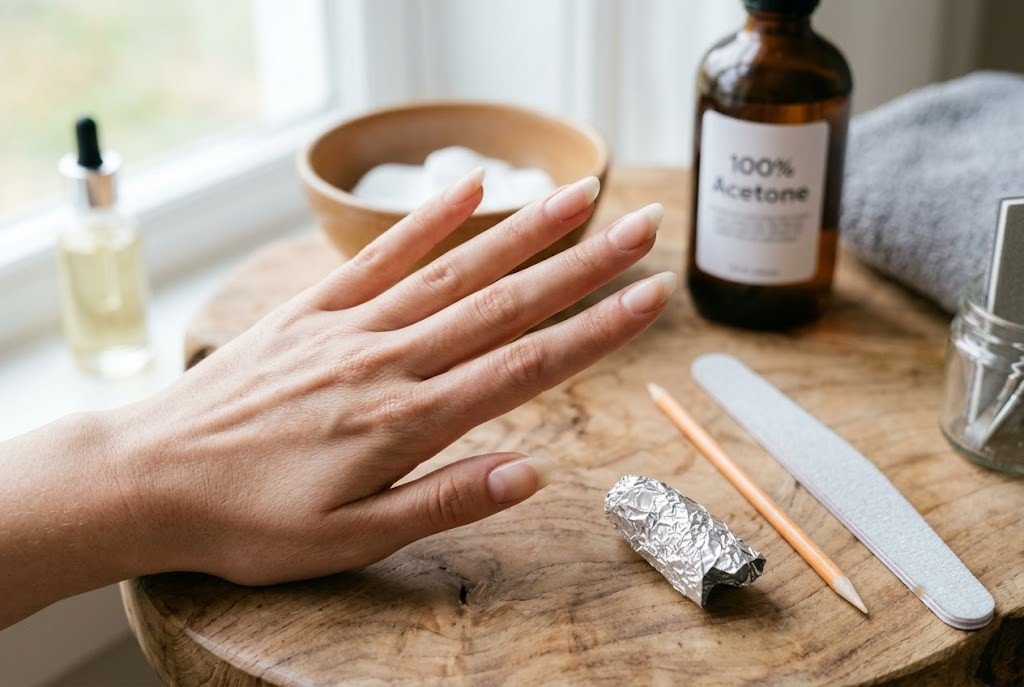
There’s no need for a fancy gel nail polish remover kit for this; instead, a few basic items that are most probably sitting in a bathroom cabinet will get this job done perfectly.
Here’s what to gather:
- Acetone: 100% pure acetone works fastest. Regular nail polish remover with acetone will work too, but just a bit slower. (Completely out of remover? Here are five things you probably already have that can do the job for regular polish — though none of them work on gel.)
- Cotton balls or pads: cut them into small pieces that are the size of your nail.
- Aluminum foil: cut one small square for each finger.
- A nail file, medium grit, is fine. Just break the seal if you’re not trying to remove the gel with it.
- A wooden cuticle stick or orange stick: You’ll need it for gently lifting softened gel.
- Cuticle oil and a nail strengthener for moisturization after your nails need rehydrating.
The filing step feels like extra work, but in our experience, the biggest mistake most people make. It isn’t extra; it’s what makes the rest of this process actually work.
How to Remove Gel Nail Polish at Home, Step by Step
This is the classic soak-off method, and it’s still the gold standard for how to remove gel nail polish at home without causing damage. It takes about 20 to 30 minutes total. Go slow. Rushing this is where nails get hurt.
Step 1: File Off the Shine
Gently buff the top layer of each nail with your medium-grit file until the shiny topcoat looks dull and matte. This step breaks the seal on the gel so acetone can actually get underneath it.
Don’t go deep, just stop the moment the surface looks frosted. You’ve gone too far if you start feeling the warmth of the nail or see your natural nail color underneath.
Step 2: Soak a Cotton Ball in Acetone
Saturate a small piece of cotton with acetone, but wet enough to feel cold against your skin without dripping. Not too much nor too little, but just enough acetone is the core of how to soak off gel nails properly without mess.
Press the soaked cotton directly onto the nail plate.
Step 3: Wrap and Wait
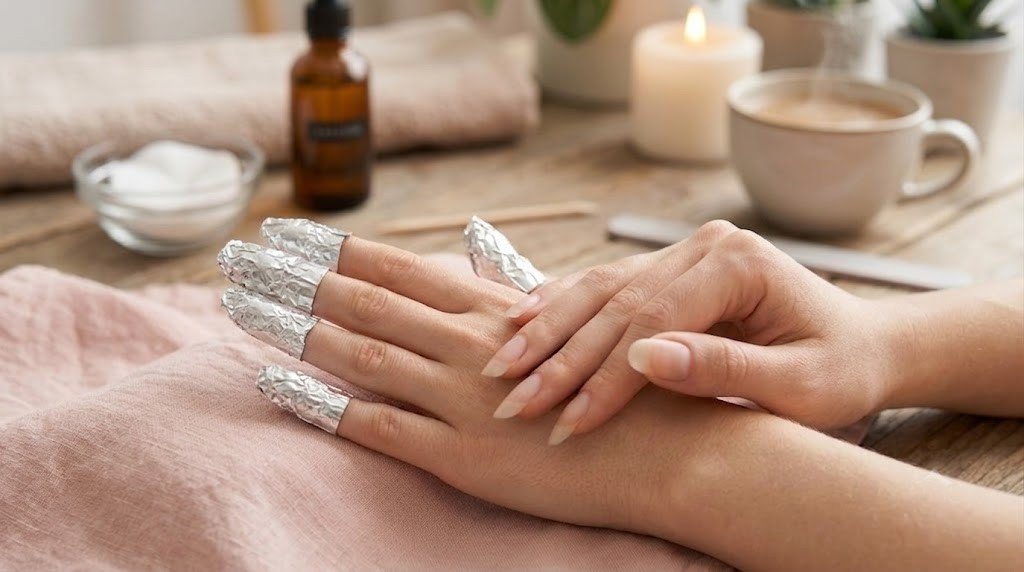
Wrap each finger in a small square of foil to hold the cotton in place. Foil traps warmth that speeds up the breakdown of the gel.
Set a timer for 10 to 15 minutes and resist the urge to check every two minutes, which just lets the acetone evaporate and slows everything down. Acetone happens to break down gel polish faster on one nail than the rest, so check that one first after 10 minutes.
Step 4: Gently Lift the Gel
Unwrap one finger at a time. The gel should look bubbled, wrinkled, or lifted at the edges. Using your wooden cuticle stick, the same tool you’d use for pushing back cuticles properly, gently push the softened polish starting from the cuticle edge without scraping.
The gel is not ready to come off if it does not move easily. Just rewrap and give it another five minutes. Forcing it now is exactly how you end up with thin and peeling nails later.
Step 5: Buff, Cleanse, and Hydrate
Lightly buff away any residue with your nail buffer when the gel is off all nails. Wipe nails down with a damp cloth or cotton pad to remove the acetone film.
This part actually matters, so make sure to apply cuticle oil generously and follow with a nail strengthener. Acetone pulls moisture out fast, so your nail bed will definitely feel it.
How to Remove Gel Nail Polish Without Acetone
Maybe you’re out of acetone or pregnant and being cautious about solvent exposure and avoiding the smell, or you just don’t love the idea of soaking your hands in solvent. There are gentler ways to remove gel nails without acetone, but they take more patience.
The most common option is the warm soapy water soak. Fill a bowl with warm water and a few drops of dish soap, and soak your nails in it for 15 to 20 minutes. The warm water will soften the gel’s bond to your nail just enough that a gentle buff with a fine-grit file can start lifting it in thin layers.
If your gel is already lifting at the edges, then this method works best. Fresh and well-bonded gel polish is much more stubborn without acetone, so you may need several rounds of soaking and light buffing.
A second option is a dedicated gel polish remover; these are acetone-free formulas that soften gel chemically rather than dissolving it outright. They require about 5 to 10 minutes of contact with the nail, which takes longer than pure acetone, but they’re a solid pick if your skin reacts badly to acetone.
Patience is the key ingredient regardless of the method. What protects your nail is going slow.
How to Take Off Gel Polish Without Foil
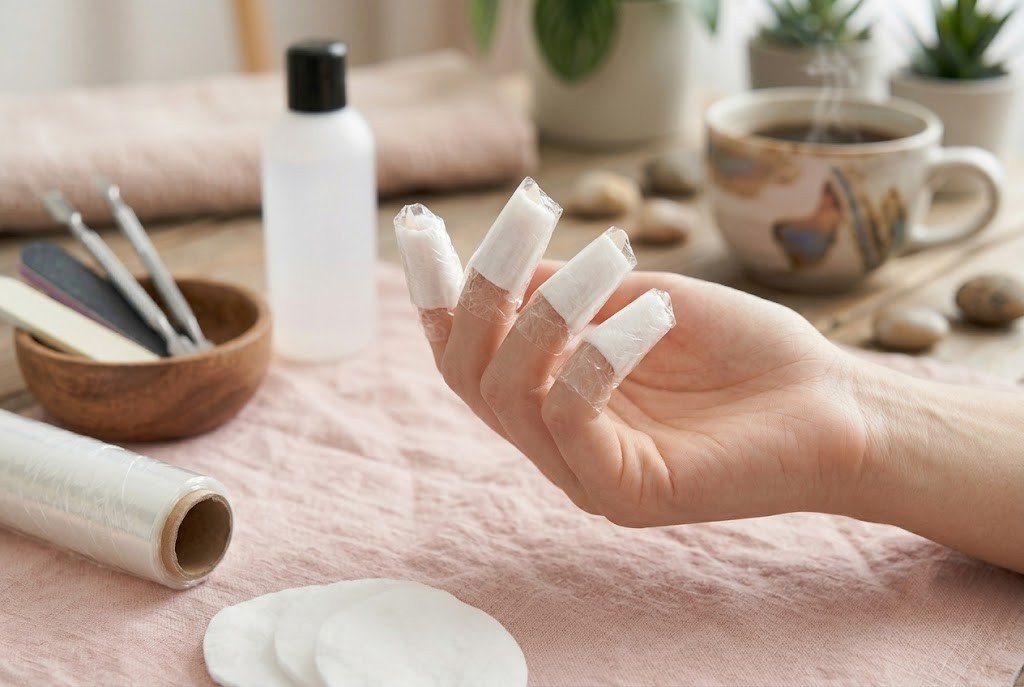
Plastic food wrap is actually the better option if there’s no foil in the house. Dermatologists tend to recommend it because it forms a tighter seal around the finger, which means less acetone drips out and more stays in contact with the nail.
Cut small squares of plastic wrap and place your acetone-soaked cotton on the nail as usual, then wrap the plastic tightly around the fingertip. A tight seal will speed things up considerably.
If you have neither foil nor plastic wrap, then small silicone finger clips (sold for exactly this purpose) work well and are also reusable. In a real pinch, even a small rubber band looped loosely around the cotton can hold it in place, but don’t wrap it so tight that it cuts off circulation. Your fingers should still feel normal but just slightly snug.
Mistakes That Make Gel Removal Worse
Most nail damage from gel removal doesn’t come from acetone itself but from what happens before and after the soak.
Peeling or picking at the gel. This is the number one cause of thin and weak nails after a gel manicure. Forcefully pulling off gel takes layers of your natural nail plate with it, even several layers sometimes.
Filing too aggressively. The goal is to dull the topcoat rather than sanding down to your nail bed. Stop immediately if your nails feel warm or sensitive during filing
Skipping the soak time. Ten minutes might feel slow when you’re impatient to be done, but pulling off cotton early and scraping at half-softened gel is one of the most common ways people end up with rough and ridged nails.
Not moisturizing afterward. Acetone dries the nail bed, and that’s its job, so do not skip cuticle oil and strengthener afterward to protect nails from being brittle for days.
Soaking too often, too close together. Repeated acetone exposure week after week without breaks between gel sets slowly wears down even healthy nails over time. Giving your nails a gel-free week between manicures makes a real difference.
When Your Nails Are Telling You Something More
Mild dryness or a slightly rough texture right after removal is just the acetone talking; that’s completely normal, and it usually settles within a day or two of consistent cuticle oil use.
But if you notice persistent white patches and feel your nails unusually thin or flexible for more than a week, or any redness, swelling, or pain around the nail fold, then it’s worth speaking to a dermatologist. According to the American Academy of Dermatology, picking or aggressive removal can sometimes cause small injuries to the nail matrix, which is the area responsible for new nail growth, and that’s something a professional should check out instead of waiting it out.
This isn’t meant to alarm you. Gel removal that is done carefully leaves nails looking a little dull for a day or two and nothing more, but listen to your nails if something feels off.
Frequently Asked Questions About Removing Gel Nail Polish at Home
Can you remove gel nail polish without acetone?
Yes, though it takes longer. Warm soapy water soaks combined with gentle filing can lift gel polish over several rounds, especially if the gel is already chipped or lifting. Acetone-free gel removers are another option if you’d rather avoid the smell or skin irritation.
How do you remove a gel manicure at home if you don’t have a nail file?
You can still soak with acetone and foil, but skipping the filing step means it’ll take longer, often 20 to 25 minutes of soaking instead of 10 to 15. A clean emery board makes the whole process much faster.
How long should you soak your nails in acetone?
Most gel polishes lift within 10 to 15 minutes when wrapped in foil with acetone-soaked cotton. Thicker builder gel or Gel-x extensions can take 20 minutes or more. Check after 10 minutes and rewrap if needed.
How do you take gel nails off without damaging them?
Go slow, file lightly, soak the full time, and never scrape or pick at gel that hasn’t softened yet. If it’s not lifting easily with gentle pressure from a cuticle stick, then it needs more soak time, not more force.
What if my nails look damaged after removing gel polish?
Some dryness and dullness are normal and fade with cuticle oil over a few days. If you notice thinness and peeling layers or discomfort that lasts beyond a week, that’s worth mentioning to a dermatologist.
Getting gel polish off without wrecking your nails really comes down to patience, not rushing it. The soak-off method works because acetone needs time to do the job acetone is good at, and your job is mostly just to wait.
The principle stays the same whether you’ve got the full kit or you’re improvising with plastic wrap and soapy water. File gently, soak fully, lift softly, and finish with cuticle oil every single time.
Once your nails are bare, it’s worth giving them a little extra care before your next set. Here’s how to strengthen weak nails after gel removal.